Here is a clear, interview-ready explanation of the Facade Design Pattern with a real-world Java/J2EE example you can use immediately.

⭐ Facade Design Pattern (Simple Definition)
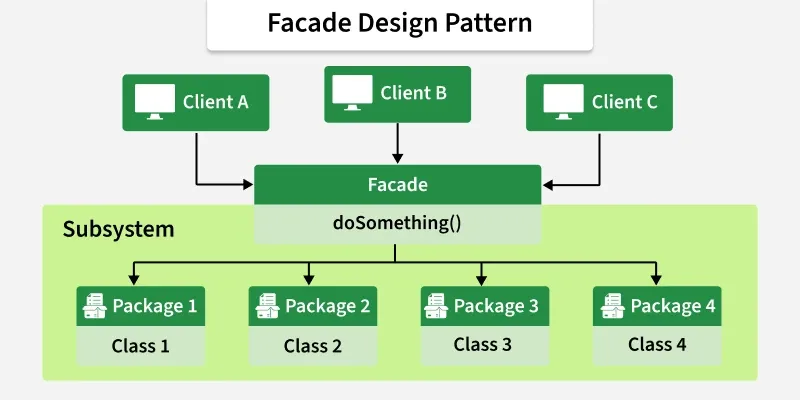
The Facade Pattern provides one simplified interface to a complex system of classes, libraries, or subsystems.
👉 It hides complexity and exposes only what the client needs.
💡 Why we use Facade?
-
To simplify complex logic
-
To reduce dependencies between client and subsystems
-
To improve readability and maintainability
-
To provide a single entry point for multiple services
🎯 REAL J2EE LIVE EXAMPLE — Payment Processing System
In enterprise Java applications (Spring Boot / J2EE), the payment process involves many subsystems:
-
CardValidatorService
-
PaymentGatewayService
-
NotificationService
-
InvoiceService
-
AuditService
The client shouldn't deal with 5–6 services every time.
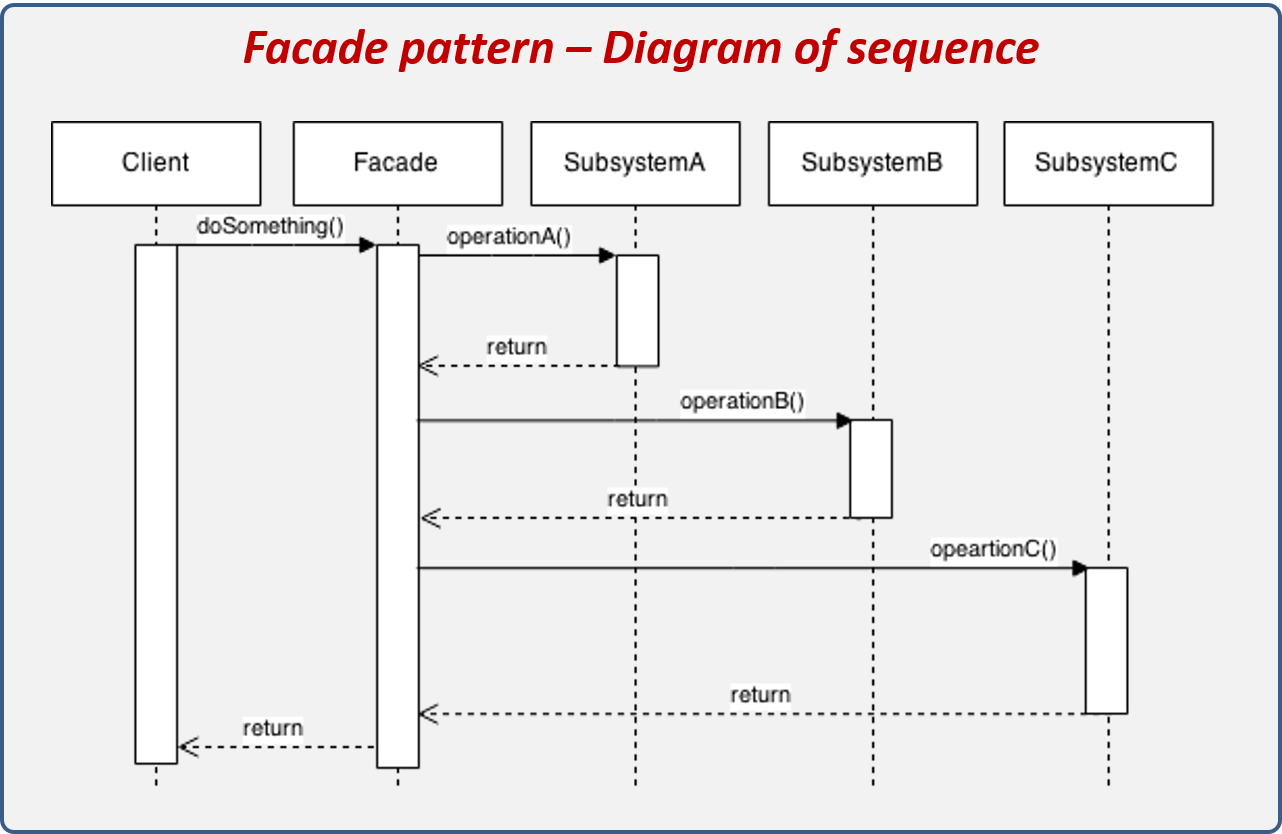
✔ So we create one Facade: PaymentFacade

✅ FACADE DESIGN PATTERN — JAVA EXAMPLE
Subsystem Classes
class CardValidatorService {
    public boolean validateCard(String cardNumber) {
        System.out.println("Validating Card...");
        return true;
    }
}

class PaymentGatewayService {
    public void debitAmount(double amount) {
        System.out.println("Debiting Amount: " + amount);
    }
}

class InvoiceService {
    public void generateInvoice() {
        System.out.println("Invoice Generated.");
    }
}

class NotificationService {
    public void sendNotification(String msg) {
        System.out.println("Notification Sent: " + msg);
    }
}
🎯 FACADE CLASS (Single Entry Point)
public class PaymentFacade {

    private CardValidatorService validator;
    private PaymentGatewayService gateway;
    private InvoiceService invoice;
    private NotificationService notification;

    public PaymentFacade() {
        validator = new CardValidatorService();
        gateway = new PaymentGatewayService();
        invoice = new InvoiceService();
        notification = new NotificationService();
    }

    public void makePayment(String cardNumber, double amount) {
        if (validator.validateCard(cardNumber)) {
            gateway.debitAmount(amount);
            invoice.generateInvoice();
            notification.sendNotification("Payment Successful!");
        }
    }
}
🚀 Client Code (Super Simple)
public class Client {
    public static void main(String[] args) {
        PaymentFacade payment = new PaymentFacade();
        payment.makePayment("1234-5678-9999", 4500.00);
    }
}
Client sees only one method:
👉 payment.makePayment(...)
All complexity stays hidden inside the Facade.
📌 Where Facade is used in real Java J2EE projects?
✔ 1. Spring Boot → Spring JPA Facade
Repositories hide DB complexity.
✔ 2. Hibernate
SessionFactory is a Facade for multiple DB operations.
✔ 3. JDBC Template
Hides connection, statement, resultSet handling.
✔ 4. Service Layer in Microservices
A Service Facade exposes one method for:
-
validation
-
calling multiple microservices
-
logging
-
auditing
✔ 5. REST API Gateways (API Gateway Pattern)
A single API endpoint calls multiple backend services.
📝 Interview-Ready Summary
Facade Pattern
👉 “Provides a single simplified interface to a complex subsystem.”
Benefits:
-
Reduces coupling
-
Easy to use
-
Clean, readable code
-
Loose coupling between layers
Real example:
-
PaymentFacade in J2EE hides card validation, debit, invoice, SMS
No comments:
Post a Comment